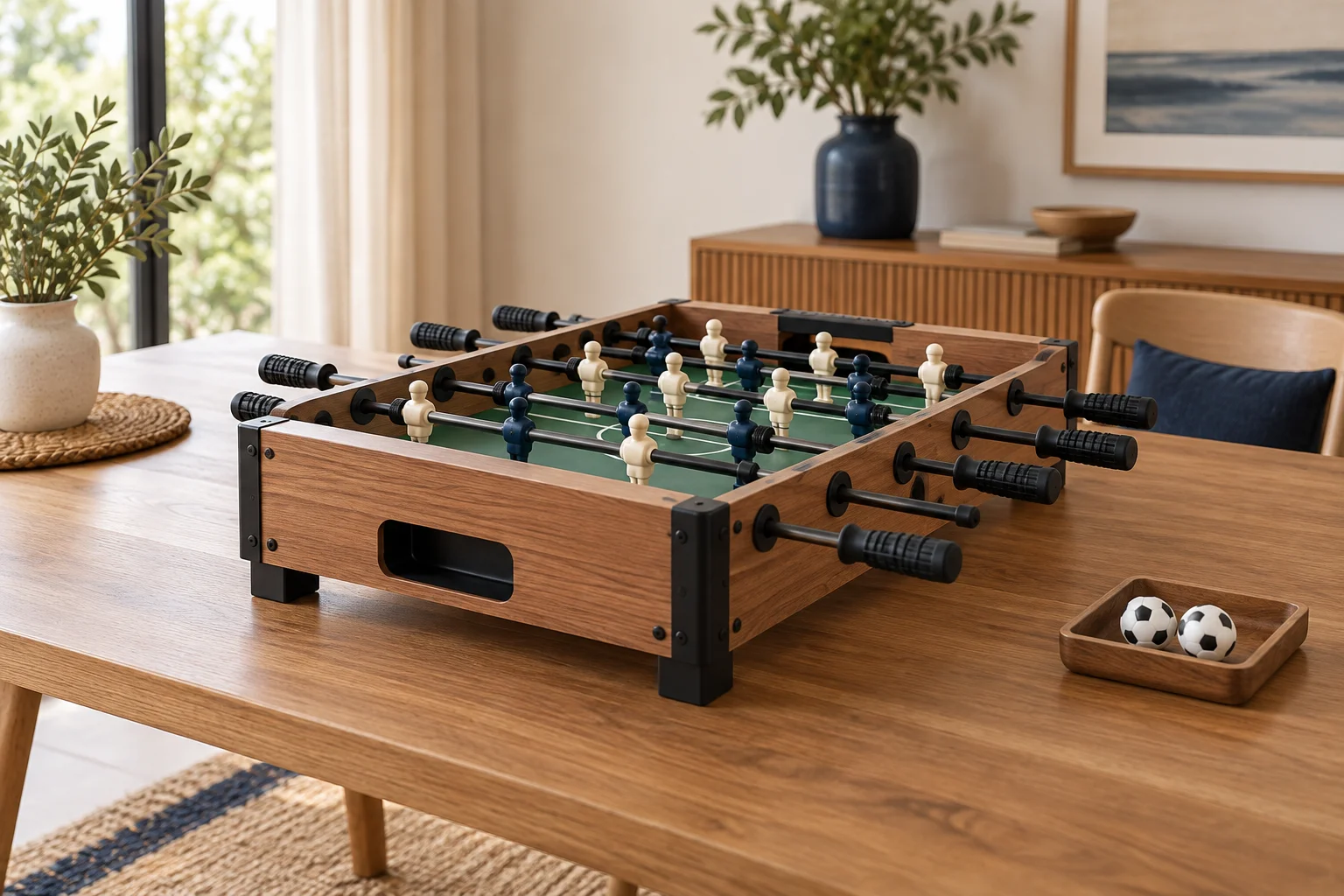
A mini foosball table needs more than a free corner on a desk. Choose a support surface that holds the complete base securely, leaves the moving rods clear, and places the handles within comfortable reach of the intended players. Check those conditions on the actual model before committing to a room or buying several units.
For retailers and group buyers, this is a practical distinction between a tabletop game and a freestanding table. The tabletop format depends on another piece of furniture. That supporting furniture is part of the setup, even when it is not included in the game purchase.
This guide focuses on selecting and testing that support arrangement for compact tabletop foosball. It does not provide a universal furniture size, load rating, or age recommendation; those details depend on the equipment instructions and the users.
Measure the base and the moving envelope separately
Start with the dimensions of the exact game you are considering. Ask which measurements refer to the frame and which include projecting rods or handles. A product name such as “mini” does not establish either measurement.
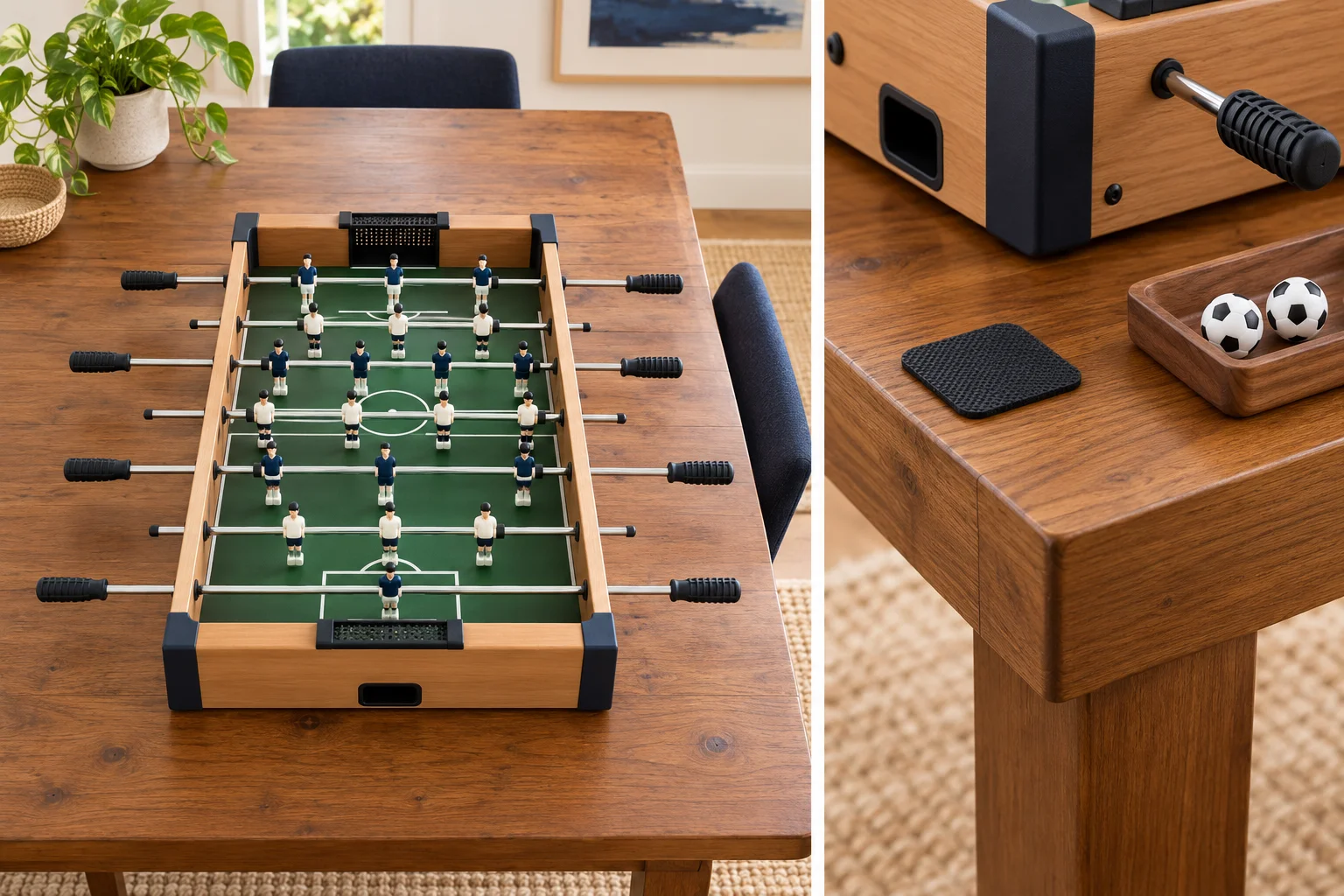
WAKUPLAY’s 13.5-inch mini tabletop foosball game is a compact two-player option with rotating steel rods and two included foosballs. Use the actual listing and assembly information to confirm its support requirements; do not treat the nominal size in the name as a complete operating-space drawing.
Make a paper outline of the base on your proposed furniture. Then identify where each handle travels during normal use. A base can fit while a moving rod still strikes a wall, nearby chair, or person using an adjacent station.
Record both checks in your purchasing notes: the area supporting the game and the surrounding area required for operation. Keep a route around the playing station so that anyone passing through does not need to step into the handle area.
Check furniture stability before gameplay
Inspect the proposed table according to its own instructions and condition. A folding table, a lightweight desk, and a solid dining table can behave differently. Do not assume a surface is suitable merely because its top is wide enough.
Confirm that furniture is fully assembled, level, and used within its stated limits. Follow any locking instructions for folding supports. Put the game in place according to the game instructions, then observe whether the support rocks or the game shifts during a controlled trial.
If the setup moves, stop and review the support arrangement. A loose improvised object under one corner is not a substitute for suitable furniture. Likewise, adding a mat should not be used to conceal a stability problem or replace required fastening.
Test handle height with the intended players
The final handle position comes from both the support table and the game resting on it. Two games placed on the same furniture may therefore feel different. Measure the assembled arrangement rather than choosing furniture height in isolation.
Ask the intended players to try their normal playing positions. Can they reach the handles without leaning across the surface? Do they have space to move their arms without contacting the other player or nearby furniture? Check seated and standing use separately if both are expected.
There is no single tabletop height that guarantees a comfortable fit for everyone. For a mixed group, a short supervised trial is more informative than a claim that every compact game suits all ages. Follow the actual product’s age guidance and small-parts warnings.
Protect the surface without changing the setup
Check the game feet and the furniture finish before first use. Consult the supplied care instructions for both. If a protective layer is permitted, choose one that stays flat and does not block supports, vents, moving parts, or any required attachment points.
Test an unfamiliar protective material on an appropriate area before extended contact with a delicate finish. Do not promise that a generic mat prevents every mark or that every rubber material is suitable for every surface. The furniture manufacturer’s guidance takes priority.
Keep drinks and unrelated objects away from the playing area. A clear surface makes it easier to see where balls and accessories have gone, and prevents the game from becoming another platform for loose belongings during a session.
Use a repeatable setup trial
- Identify the exact game and read its assembly instructions.
- Check the support furniture and position the entire base as directed.
- Move each rod through its permitted travel with the area clear.
- Try the intended player positions without crowding neighboring stations.
- Run a short game and watch for shifting, rocking, or difficult reach.
- Collect the balls and return the area to its normal use.
Record observations rather than broad judgments. “Right handle contacted the chair at full travel” gives a clear reason to reposition the station. “Too small” does not explain whether the problem is the playing field, support furniture, or space around it.
For an organization preparing multiple stations, use the same checklist at each location. Identical games can perform differently when placed on different furniture. Review the arrangement again if the room layout or intended users change.
Plan where the game goes afterward
A compact game may be easy to move compared with larger equipment, but portability should still be checked against the actual weight, shape, and lifting guidance. Do not assume that carrying it by the rods or handles is acceptable.
Choose a storage position that supports the game as instructed and protects projecting parts. Measure the stored configuration, including rods, rather than just the frame. Do not assume it can stand upright, hang from hardware, or be stacked beneath other objects unless the instructions permit that.
Use a separate container for loose balls and any supplied accessories. Label it with the model so pieces from another game are not mixed in. Check the inventory before the next session instead of discovering a missing ball after players arrive.
What changes with a multi-game tabletop set?
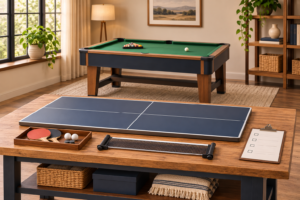
If the same furniture will support more than foosball, repeat the setup review for each activity. WAKUPLAY’s 20-inch 3-in-1 tabletop game set combines foosball, table hockey, and table tennis with interchangeable surfaces. The furniture arrangement must suit the active configuration, not only the foosball frame.
Ask where unused boards and accessories will rest during a session. Do not place them where they interfere with handles or require players to reach across an active game. Keep the changeover instructions available so the next user can restore the correct setup.
The same principle applies when exploring 4 in 1 table games: extra activities add setup questions rather than proving that any existing desk will work. Compare actual assembled and stored configurations instead of selecting only by the game count.
Frequently asked questions
Can I use any dining table for tabletop foosball?
No universal recommendation fits every model and table. Check the complete base, stability, moving handles, surface care, and final playing height against the equipment and furniture instructions.
Does a mini foosball table need clearance on both sides?
Check every moving rod and both players’ positions. The space needed depends on the actual mechanism and the room, so a nominal frame width is not enough for planning.
Can I store the game on its side?
Confirm the allowed storage orientation with the instructions or supplier. Protecting rods and supporting the frame matter more than finding the smallest apparent gap on a shelf.
Request a model-specific setup brief
Before a bulk purchase, send WAKUPLAY your tabletop game requirements: preferred model, quantity, support furniture dimensions, intended users, storage arrangement, and destination. Request the current dimensions, packing list, and setup information so the final choice fits the place where it will actually be used.