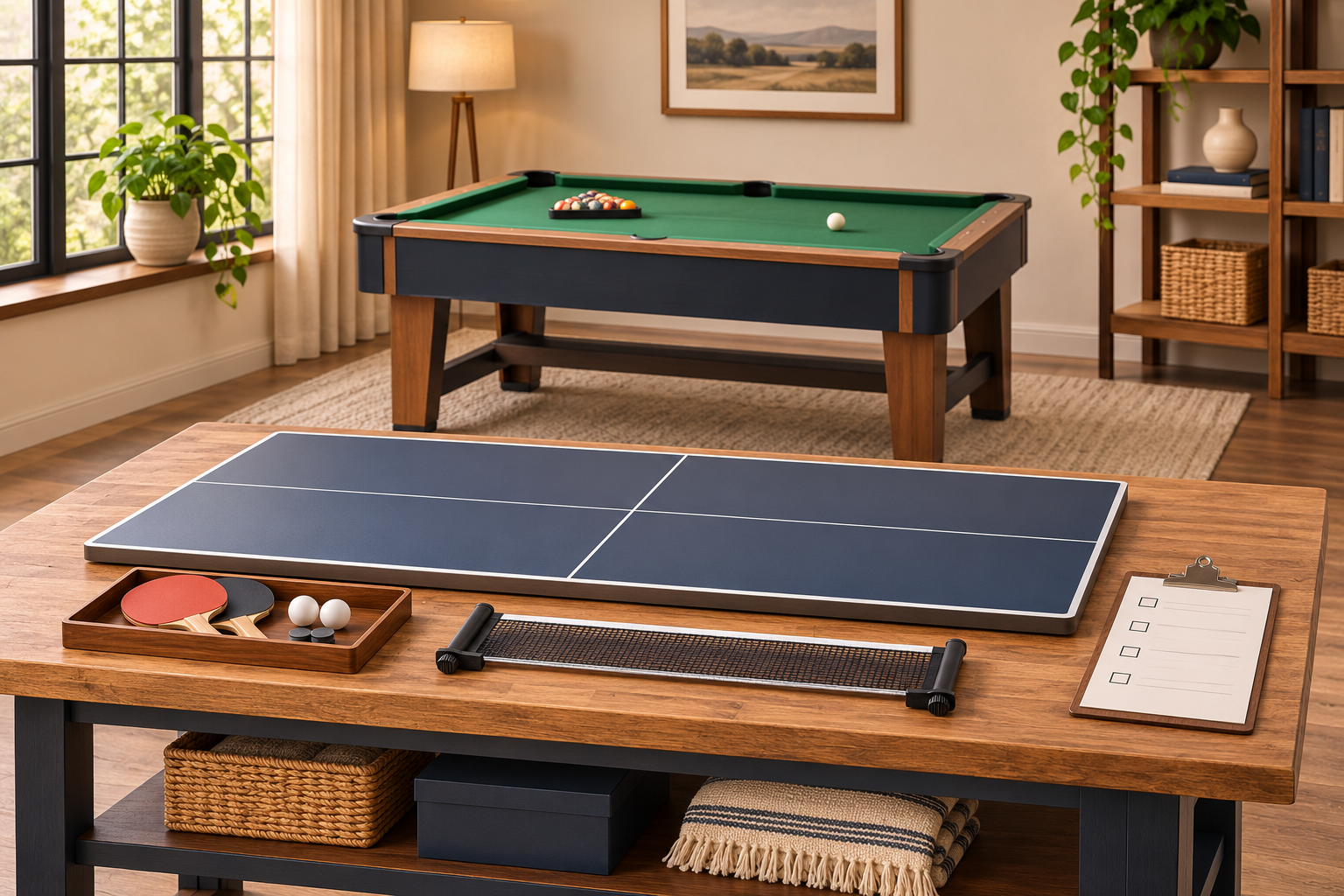
A 4 in 1 multi game table changeover demo should show the table being switched between two games your group will actually play. Ask to see the full transition from a ready-to-play first mode to a ready-to-play second mode. That includes removing loose pieces, handling the surface, setting up the next game and performing the checks called for in the model’s instructions.
A good demo helps you decide whether your staff or household can repeat the switch in the available space. It also helps a buyer compare two tables that list similar games but may use different parts and procedures. Ask for the exact model being quoted and get its instructions before trying the changeover yourself.
Choose two games your group will switch between
Start with the pair of activities that will occur most often. A family might go from pool to table tennis. An activity room might switch from foosball to table hockey. Ask whether the same process applies in the reverse direction, since loose accessories and the removed surface will need to go somewhere different.
WAKUPLAY’s compact 4 in 1 multi game table lists foosball, pool, table hockey and table tennis with interchangeable surfaces. The folding multi sports game table lists pool, foosball, non-electric slide hockey and table tennis. Ask for separate instructions for each shortlisted model. Record the mode names as the product lists them so everyone is discussing the same setup.
If your group expects frequent switches, put that in the request. A household leaving the table in one mode for a week has a different routine from a venue rotating activities during one afternoon. A complete changeover video is particularly useful when the people who will use the table cannot attend a sample demonstration.
Set a clear beginning and end for the demonstration
Start with the first game assembled and its pieces in their normal playing positions. Ask the demonstrator to clear it as they would after use. Record whether the instructions call for additional people, a tool or a particular order for removing accessories. If any items are removed before the demo begins, ask to see that stage separately.
End when the new mode is ready for its intended play. If the new mode needs a net, loose pieces or another accessory, include those tasks. A board placed on the frame may be only one part of the transition. If you track time during a trial, note who performed the tasks, what was already prepared, and whether the reverse switch was included. The observed duration applies to that trial.
Watch where the removed parts go
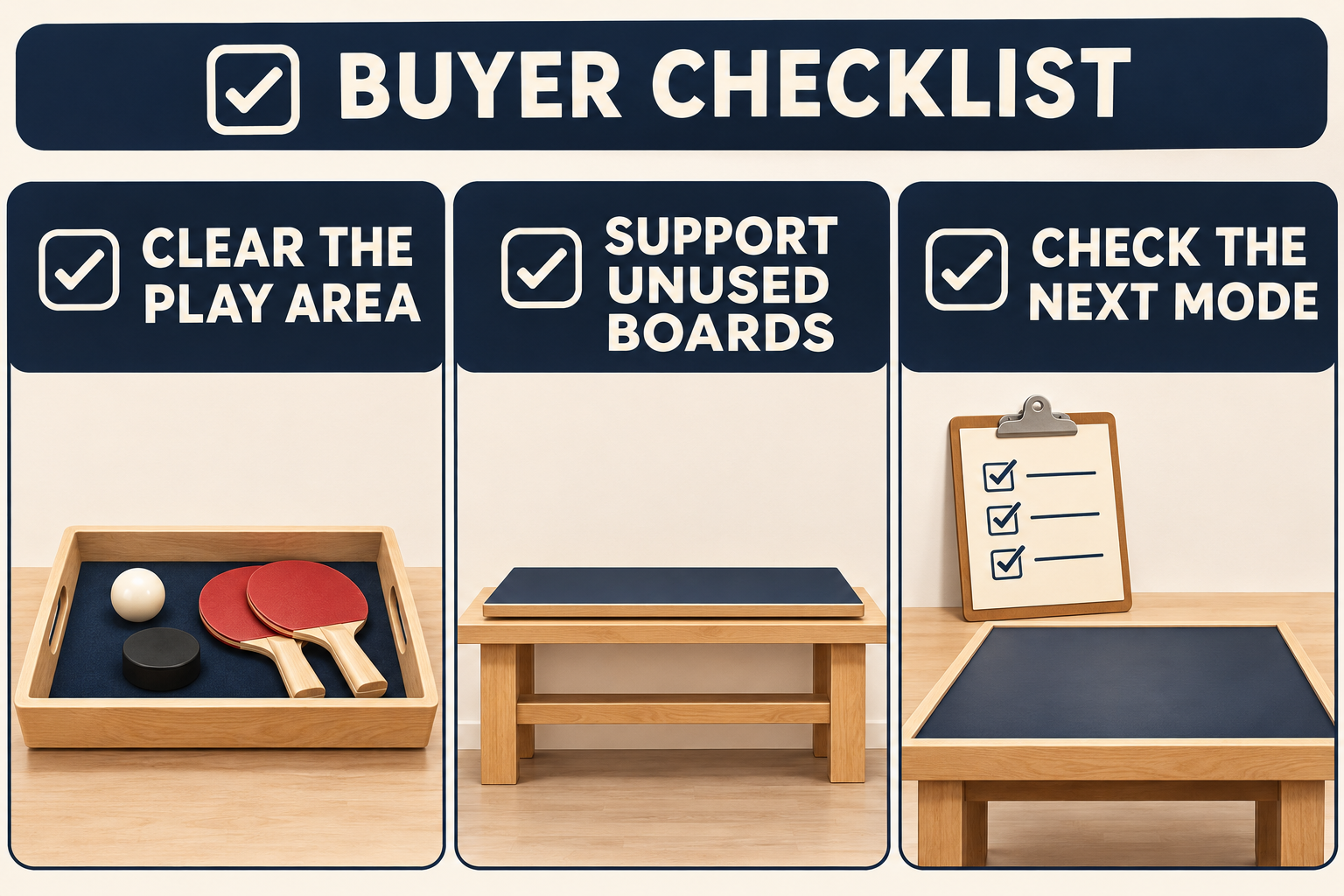
Ask the demonstrator to point out the surface or container used for each removed part. Check that the board can be supported in the position allowed by the manufacturer and that there is a designated place for the parts you have just taken off. If the demo relies on a nearby bench, compare the bench and available space with what you actually have.
Pay attention to where people stand during the move, including how they get around the ends of the frame. Measure the area you can provide and ask for the model’s handling guidance. Include any rods or other elements that project beyond the play surface when you explain the room layout. Keep the planned route clear during the trial.
Ask the demonstrator to show the checks for the new mode
Have the demonstrator explain how they know the new board is in its intended position. If the instructions specify locators, fasteners or a particular orientation, ask to see those exact points on the sample. The demo should identify what needs to be checked before play and what to do if something does not sit as described.
Once the intended checks are complete, observe a short ordinary play test appropriate for that mode. Look for issues you can describe plainly, such as a net placed differently from the instructions or a loose part still in the playing area. If the next mode uses the same frame in a different position, confirm that part of the setup from the manual.
Ask for clarification if a demo relies on an extra support or tool that the quote does not list. Record which items belong to the model and which are part of the buyer’s room setup. The four-game table accessory checklist helps reconcile the supplied parts with the list used in the trial.
Use the same review sheet for every sample
| Observe | Record |
|---|---|
| Starting and ending games | Exact model, first mode and next mode |
| People and tools | Manufacturer’s handling requirements and tasks seen |
| Where parts go | Board support location and places for removed accessories |
| Readiness checks | What the demonstrator checked before starting play |
| Follow-up | Open questions, requested instructions and any repeat trial |
When comparing models, use the same starting conditions and next activity where practical. Note when one demonstration is performed by someone familiar with the model and the other by a first-time operator. If your acceptance requirement is that two trained staff members can switch modes within the room layout, test that requirement with those conditions and document what happened.
For an order going to several sites, identify which conditions differ between rooms. One location might have a work surface nearby while another has only the table and its included storage. Give the supplier enough detail to answer the handling questions for each location, then decide which arrangements your team can repeat.
Frequently asked questions
Can one person do the switch?
Ask for the handling requirements for that exact model and transition. Have the demonstrator follow them, and plan staffing accordingly.
Does a folding table change games in the same way as a compact table?
Review the folding and mode-change instructions as separate tasks. Ask whether the table must be positioned a particular way to switch surfaces and which pieces must be removed first.
What should I send with a demo request?
Send the model, two games you want to switch between, available handling space, expected operators and any acceptance requirements. Ask WAKUPLAY for the model instructions and demo options and include the intended quantity and destination so the team can respond to the actual inquiry.