Before buying mini foosball replacement balls, identify the exact game and compare the candidate with the original ball. Ask for confirmed compatibility, then test a sample through the model’s intended playing and return paths. A listing that says “foosball ball” is not enough information to establish fit.
This is a purchasing guide for replacing a lost or unsuitable ball in a compact tabletop game. It does not prescribe one universal diameter, promise that WAKUPLAY supplies every spare part, or recommend changing the table to accept an unconfirmed replacement.
Identify the game before searching for a ball
Record the model, order reference, and any identification on the packaging or instructions. Include a clear overall photograph if the reference is uncertain. The phrase mini foosball covers equipment with different constructions, so a general category name is a weak starting point for a spare-part request.
WAKUPLAY’s 13.5-inch mini tabletop foosball game lists two included foosballs. That confirms the supplied accessory count, not a universal replacement size or a guarantee that a ball from another model will work.
If the original packaging is unavailable, describe the game as accurately as possible and ask the supplier to identify it. Do not turn an approximate table length or a visual resemblance into a definite model match.
Keep an original ball as the reference when possible
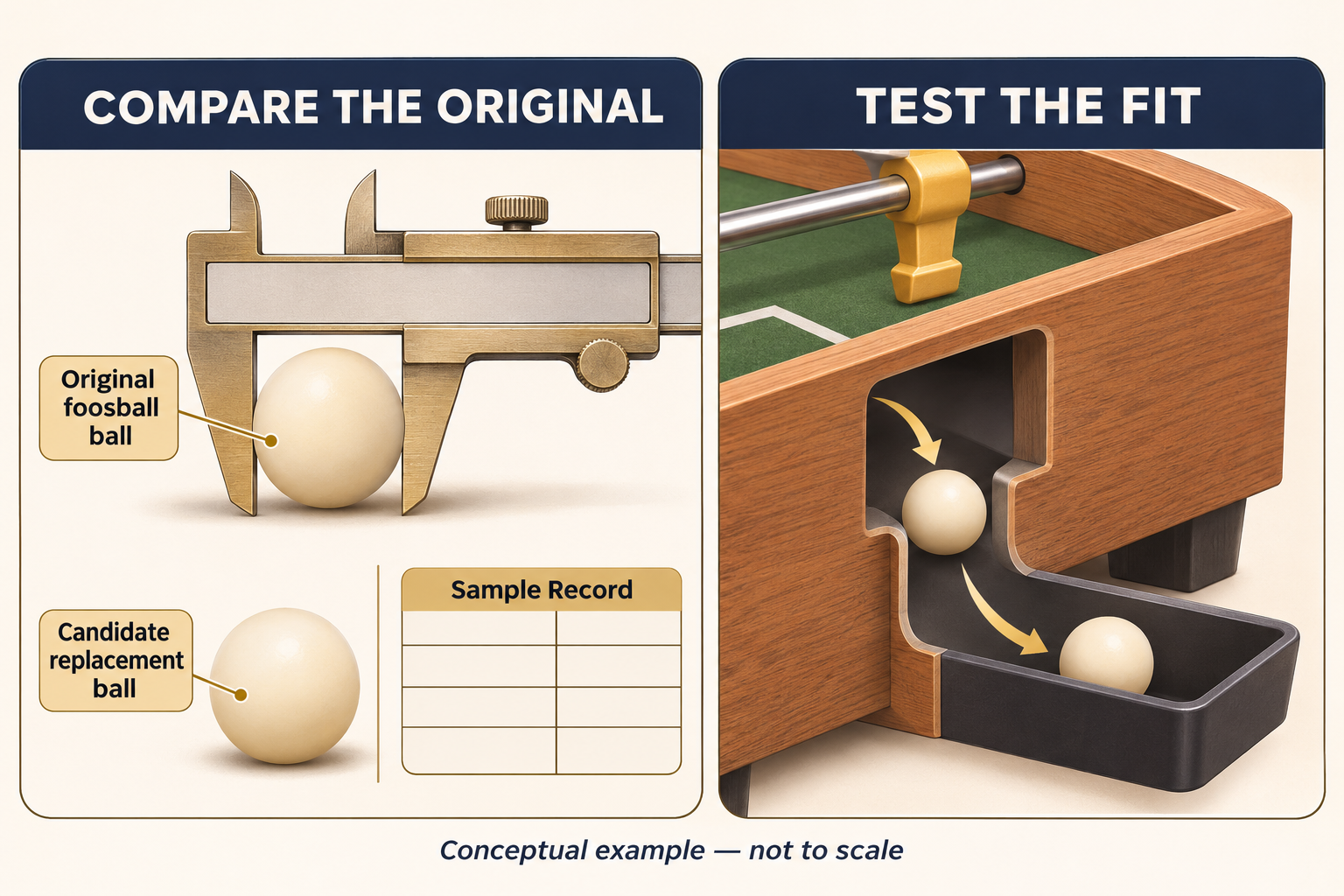
If one ball remains, set it aside while comparing candidates. Photograph it from several angles and record the dimensions requested by the supplier. Keep the unit of measurement explicit so a number is not mistaken for millimeters, centimeters, or inches.
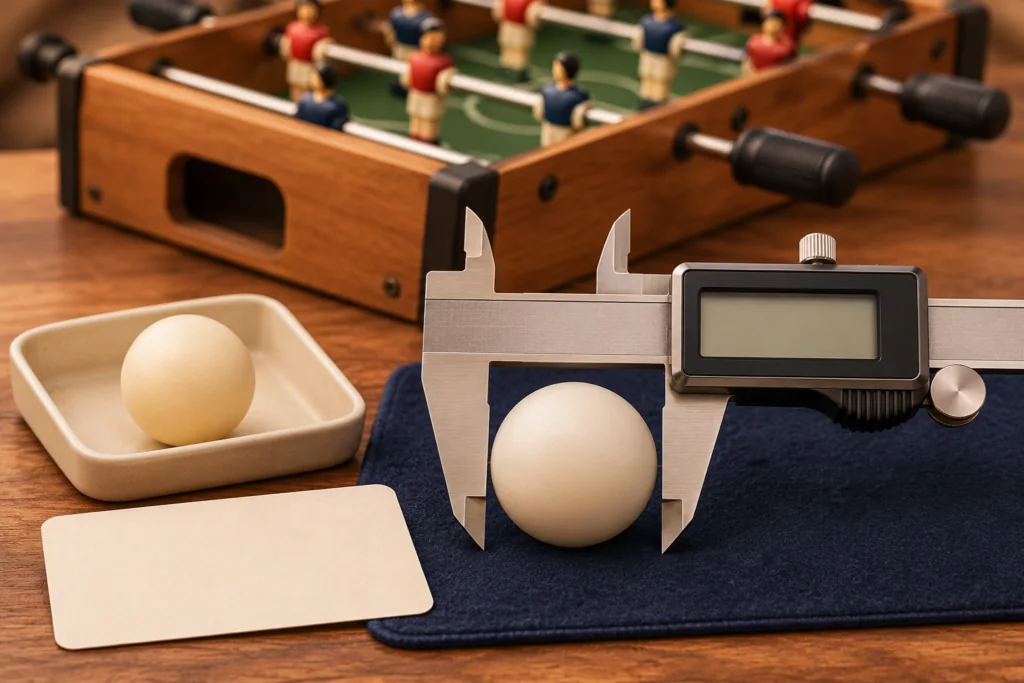
A caliper can help record diameter, but use it carefully and note what was actually measured. Check across more than one orientation if a result seems inconsistent. Do not squeeze, flatten, or otherwise alter the reference simply to obtain a measurement.
If every original ball is missing, state that clearly. Request the model’s specified accessory or a confirmed substitute rather than reconstructing the specification from an unrelated product photo. There is no need to invent a size to make an inquiry sound complete.
Ask about more than diameter
Diameter is useful information, but it is not the whole purchasing brief. Ask what material and surface finish the proposed ball has, and whether that combination is intended for the identified game. Record the answer rather than assuming every similarly sized ball behaves the same.
If weight is part of the supplier’s specification, ask for that figure and its unit. Do not claim a particular weight or texture is always best for every tabletop game. The appropriate reference is the actual model and its documented accessory requirements.
For repeated organizational use, consistency between replacement batches may matter. Ask whether the quoted item has a stable reference and whether later orders can be checked against the same description. A sample without an identifiable specification can be difficult to reorder reliably.
Check the paths the ball must use
Review the instructions before testing a sample. Identify the intended entry method, playing surface, goal opening, collection area, and any return route that the particular model uses. Not every game has the same ball-return arrangement.
Where the instructions permit, check that the candidate can enter, move through normal play, reach the goal, and be collected without forcing it. Stop if it catches or requires unusual pressure. Do not remove guards, enlarge openings, or bend components to make a trial ball pass.
A ball that fits through one opening has passed only that particular check. It still needs evaluation in the rest of the permitted path. Keep the original and the candidate identified throughout the trial so a successful test is attributed to the correct piece.
Evaluate play on the actual supported setup
Place the game on the suitable support described in its instructions. An unstable or sloping arrangement can complicate a comparison, so settle the setup before deciding that a candidate ball is the cause of every problem.
The mini foosball support-surface guide covers that preparation. For this test, keep the setup consistent between the original and replacement, and follow the same ordinary playing actions.
Record observations in plain language: whether the ball travels freely, can be reached during normal play, enters the intended goal, and can be recovered. A short controlled trial is evidence about the tested sample and setup, not proof of long-term durability or suitability for every user.
Keep multi-game accessories separate
A multi-game set may contain several round objects that serve different activities. Identify them by the model’s packing list rather than treating every small ball in the box as interchangeable.
The 20-inch 3-in-1 tabletop game set lists foosballs, hockey pucks and pushers, and table-tennis balls and paddles as separate accessories. Its list is a useful reminder to name the activity as well as the game-set model when requesting a replacement.
Do not substitute a table-tennis ball or a hockey component just because it is available nearby. Confirm the intended accessory and its compatibility. This also applies when several similar tabletop games are stored together in one activity cupboard.
Write a replacement request that can be answered
| Information | Useful detail |
|---|---|
| Equipment | Exact model, order reference, and overall photo |
| Original accessory | Available sample, photos, and measured dimensions with units |
| Candidate | Supplier item reference, stated material, finish, and size |
| Trial result | Observed fit through the model’s intended paths |
| Order scope | Quantity, destination, and whether several models are involved |
If a retailer or organization needs spares for multiple models, make separate lines for each. Do not consolidate the order into one mixed quantity until compatibility has been confirmed for every affected game.
Ask about current availability, packing units, sample arrangements, and the quoted specification. Keep price and timing as questions for the actual inquiry; an editorial guide cannot establish those terms for a future order.
Retain the approved reference for later orders
Once a candidate has been confirmed and tested, retain its item reference and the supplier’s response with the equipment record. If practical, keep an identified reference sample separate from the everyday playing supply.
When the next delivery arrives, compare it with that record before mixing it into existing stock. If its appearance or specification differs, clarify the difference instead of assuming that a familiar product name guarantees the same accessory.
Where an instruction or intended-user restriction applies, follow it for replacement parts as well as for the complete game. A change of ball does not create a new age rating, safety certification, or approved use for the equipment.
Frequently asked questions
Are mini foosball balls all the same size?
Do not assume one universal specification. Obtain the requirement or confirmed replacement for the exact game rather than borrowing a measurement from another model.
Is matching the diameter enough?
No single measurement establishes the complete result. Confirm the specified accessory and evaluate the permitted playing, goal, and collection paths with an identified sample.
Can I order loose replacement balls from WAKUPLAY?
Ask about the particular model and quantity. Included balls in a game-set listing do not, by themselves, confirm that a separate spare-ball item is currently available.
To ask WAKUPLAY about a foosball replacement requirement, send the equipment reference, original-ball information, photos, quantity, and destination. Request compatibility confirmation before choosing a substitute or planning a bulk spare-parts order.