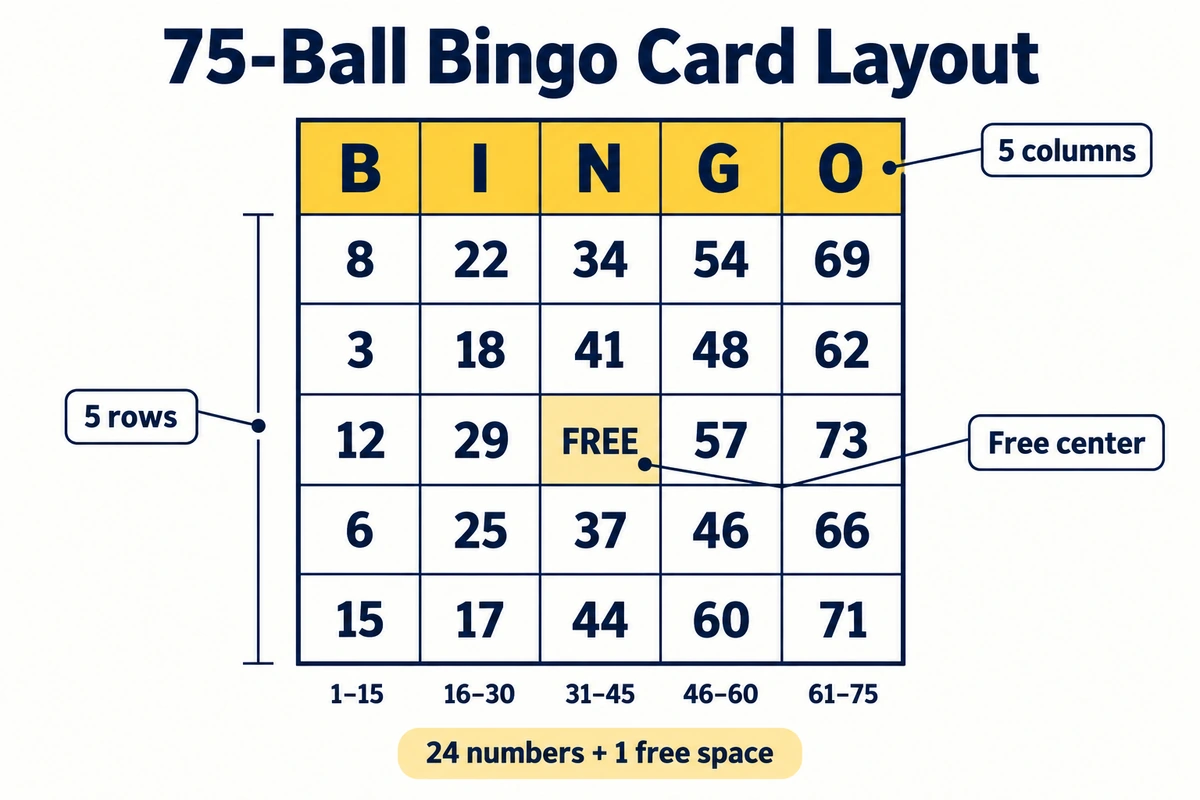
To play bingo, mark the numbers on your card as the caller announces them. Complete the winning pattern announced before the round, call “Bingo!”, and have your card checked. In standard American 75-ball bingo, players use a five-by-five B-I-N-G-O card with 24 numbers and a free center square.
This guide explains how to play bingo using the 75-ball format, including card rules, common patterns, and beginner mistakes. We also compare it with 90-ball bingo and share practical planning advice for schools, senior living communities, and event organizers.
What Do You Need to Play Bingo?
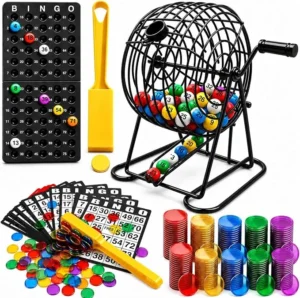
A basic bingo setup needs cards, a way to select numbers randomly, and a method for marking and recording those numbers.
- Bingo cards: Provide cards designed for the format you are playing. Different number arrangements help avoid identical results across players.
- A number-drawing system: Use a complete ball set with a suitable cage or blower, or a number generator that draws without repeating numbers during the round.
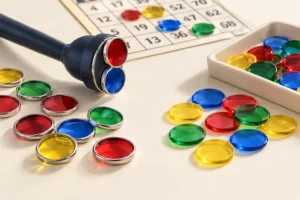
- Markers: Use removable chips with reusable cards, or suitable daubers or pens with disposable paper cards.
- A caller’s record: Keep a call sheet, master board, or digital record of every number announced.
- A winning-pattern display: Show players what they need to complete before the round begins.
For a small practice game, one card per person is a manageable starting point. Larger groups also benefit from clear sound, good lighting, and a visible display of called numbers.
How to Read a 75-Ball Bingo Card
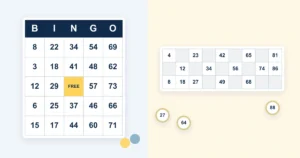
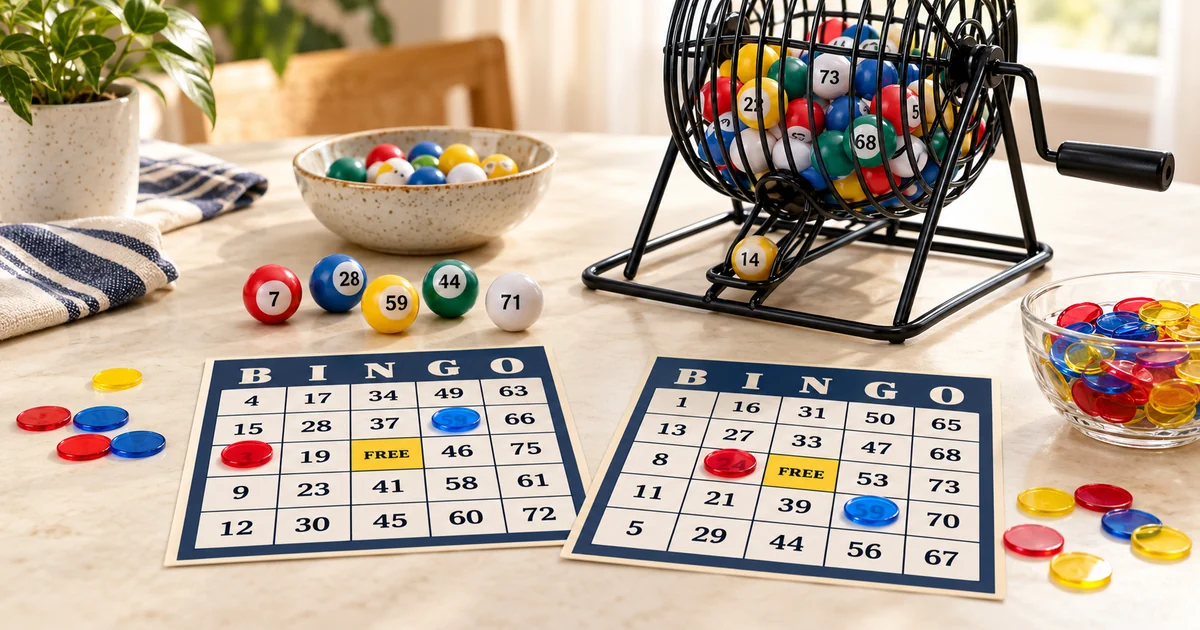
A standard 75-ball card has five columns labeled B, I, N, G, and O. Each column uses its own number range.
| Column | Number range |
|---|---|
| B | 1–15 |
| I | 16–30 |
| N | 31–45 |
| G | 46–60 |
| O | 61–75 |
The center square is normally marked FREE. It counts as covered from the start and helps complete any winning pattern that passes through it.
For example, when the caller announces “G-52,” look only in the G column. If your card contains 52, mark it. If it does not, wait for the next call.
These card conventions are described in the Grand Ronde Gaming Commission’s bingo rules. Individual venues may set additional requirements for claiming and verifying a win.
How to Play Bingo: Step by Step
1. Get Your Card and Markers Ready
Check that your card is readable and matches the game format. Place it where you can see every square, and mark the free center if your card uses one.
Start with one card while learning. Add more only when you can follow the calls comfortably.
2. Confirm the Winning Pattern
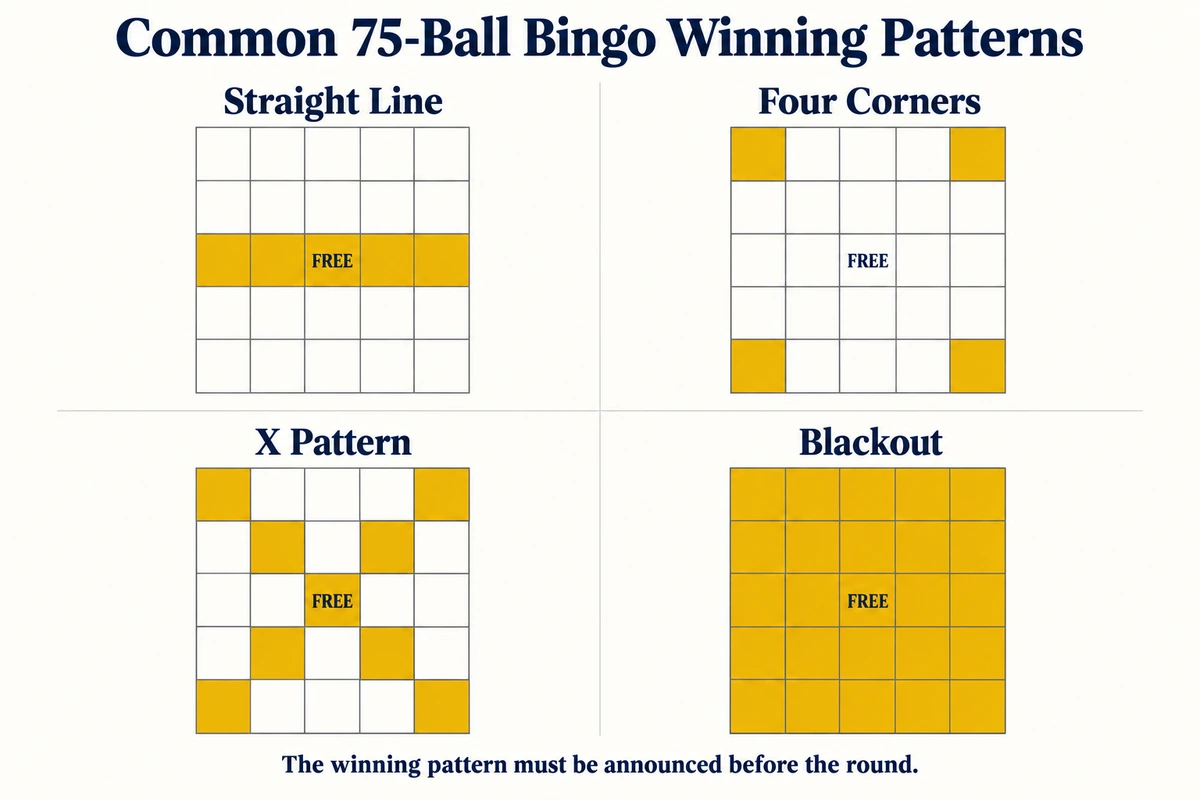
The organizer should announce the target before drawing the first number. A straight line, four corners, and a blackout are different games: completing one does not win a round that requires another.
Also confirm how to claim a win and how simultaneous winners will be handled.
3. Listen to Each Call and Mark Matching Numbers
The caller randomly selects a number and announces it clearly, usually with its letter in 75-ball bingo. Check the matching column and mark the number only if it appears on your card.
Drawn numbers stay out of the selection pool until the round ends. The caller should record each announced number so claims can be checked accurately.
4. Check Your Progress Against the Pattern
Keep watching the pattern you are trying to complete. In an “any straight line” round, a horizontal, vertical, or diagonal line may qualify. Other rounds may allow only a specific line or shape.
If you miss a call, ask for clarification or check the official display. Do not guess and mark a number you did not confirm.
5. Call “Bingo!” and Wait for Verification
As soon as you complete the required pattern, announce “Bingo!” clearly. Leave your markers in place while the caller checks your card against the official record.
The organizer confirms whether the claim meets the round’s rules. Timing requirements, including whether the winning pattern must contain the last number called, depend on the venue’s rules.
6. Reset Before the Next Round
Wait until all claims are resolved before clearing your card. For a new independent round, remove reusable markers and return all balls to the drawing system. Use fresh paper cards when needed.
Some sessions continue the same draw toward another pattern. In that case, keep your marks until the caller tells you to reset.
Common 75-Ball Bingo Winning Patterns
Patterns are chosen by the organizer. The following are common examples, rather than winning conditions that automatically apply to every game.
| Pattern | What to cover | How the free space applies |
|---|---|---|
| Straight line | One permitted horizontal, vertical, or diagonal line | A line through the center needs four called numbers; other lines need five |
| Four corners | The four outer corner squares | The center does not contribute |
| X | Both full diagonals | The shared center is free, leaving eight numbered squares |
| Blackout or coverall | Every numbered square | All 24 numbers must have been called |
Example: If your middle horizontal row contains B-8, I-22, FREE, G-54, and O-69, you complete that line when all four numbered squares have been called—provided that line is an eligible winning pattern.
For group events, display a simple pattern diagram and point out whether the center counts. This is especially helpful when moving from a line game to four corners or an X.
75-Ball vs. 90-Ball Bingo
American 75-ball bingo and UK-style 90-ball bingo use different cards and winning structures. Confirm the format before buying supplies or distributing tickets.
| Feature | 75-ball bingo | 90-ball bingo |
|---|---|---|
| Numbers drawn | 1–75 | 1–90 |
| Card or ticket layout | Five rows and five columns | Three rows and nine columns |
| Numbers per card or ticket | 24 numbers plus a free center | 15 numbers, with five in each row |
| Free center | Normally included | Not used; blank spaces are not numbers to mark |
| Typical winning structure | A designated line or pattern | One line, two lines, and full house |
| Common regional association | United States and Canada | United Kingdom and other markets |
In a typical 90-ball game, one line means marking all five numbers in one horizontal row. Two lines means completing two rows on the same ticket. A full house means marking all 15 numbers on that ticket. These stages are described in Mecca Bingo’s explanation of 90-ball bingo.
Do not apply 75-ball diagonal or four-corner patterns to a standard 90-ball session unless the organizer has explicitly announced a special variation.
Beginner Tips and Common Mistakes
- Follow the announced pattern: Five marked squares do not necessarily form a valid win.
- Check the letter as well as the number: It helps you find the correct column quickly.
- Use only as many cards as you can manage: Missing calls makes the game harder to follow.
- Keep your marks clear: Avoid covering neighboring numbers or moving chips accidentally.
- Claim promptly: Follow the organizer’s instructions rather than waiting for several more calls.
- Leave the card intact for checking: Clearing it too soon can make verification difficult.
Bingo is a game of chance. These tips help you play accurately and enjoy the session; they do not control the draw or guarantee a win.
Planning Bingo for Schools, Senior Communities, and Events
Schools and Classroom Groups
Begin with a short demonstration and one card per participant. Show a sample winning line before starting. Choose markers suitable for the children’s ages, and avoid small loose pieces where they would be unsuitable.
If you adapt the game to pictures, vocabulary, or arithmetic, explain that it is a classroom variation rather than standard numbered 75-ball bingo.
Senior Living Communities
Consider readable number sizes, strong contrast, accessible seating, and markers that participants can handle comfortably. Ask the group what works for them rather than assuming everyone needs the same setup.
Use a steady calling pace, repeat numbers when needed, and make the winning pattern visible throughout the round.
Community Events and Event Organizers
Run a practice round before the main session. Assign someone to record calls and another person to help check claims when the group is large. Explain tie handling before play begins.
Prepare spare supplies and keep the drawing equipment organized. If a ball is missing, replace it before using that set for a standard game.
A Bingo Supply Checklist for Wholesale Buyers
At WAKUPLAY, we approach game sourcing around the intended activity and audience. Before preparing a bulk inquiry, define the setup you need:
- The format: 75-ball or 90-ball.
- The expected player count and cards per player.
- Reusable cards with chips or disposable cards with suitable markers.
- Required print size, contrast, and handling needs.
- Compatibility between the balls, drawing equipment, and call board.
- Replacement requirements, packing preferences, and delivery destination.
For example, 60 participants playing one card each require 60 playable cards, plus any spares you choose to keep. That planning figure is separate from a supplier’s pack quantity or minimum order, which should be confirmed for the actual product.
Distributors serving different markets should also confirm the expected bingo format before selecting an assortment.
Frequently Asked Questions
Do you always need five numbers in a row to win?
No. The organizer defines the winning pattern. A straight line covers five squares, but a line passing through the free center requires only four called numbers. Other rounds may require four corners, an X, or a blackout.
Does a blackout require all 75 numbers to be called?
No. A standard card contains 24 numbers and a free center. A blackout requires all 24 numbers on that card to have been called, not every number in the full 75-number set.
Can two players win on the same call?
Yes. Different cards can complete the required pattern on the same call. The organizer should verify every eligible claim and apply the tie rules announced for the session.
Can bingo cards be reused?
Reusable cards can be played again with removable markers. Paper cards marked permanently with daubers or pens generally need replacing for a fresh round. Check the intended marking method before ordering.
How long does a bingo round take?
There is no fixed duration. The pattern, calling pace, number of cards in play, and time needed to verify claims all affect the schedule. Test your planned format before promising a specific event timetable.
Prepare for Your Next Bingo Session
Start with the right format, show the winning pattern, and give players time to learn the card. Clear instructions and a reliable record of called numbers make the session easier for both players and organizers.
For your next school activity, community event, or wholesale sourcing project, explore our Bingo Games collection. You can also explore our game collections or contact us for wholesale inquiries with your player count, preferred format, and sourcing requirements.